Full-Body Coating a Jeep: Coverage, Weight, and Cost
On this page
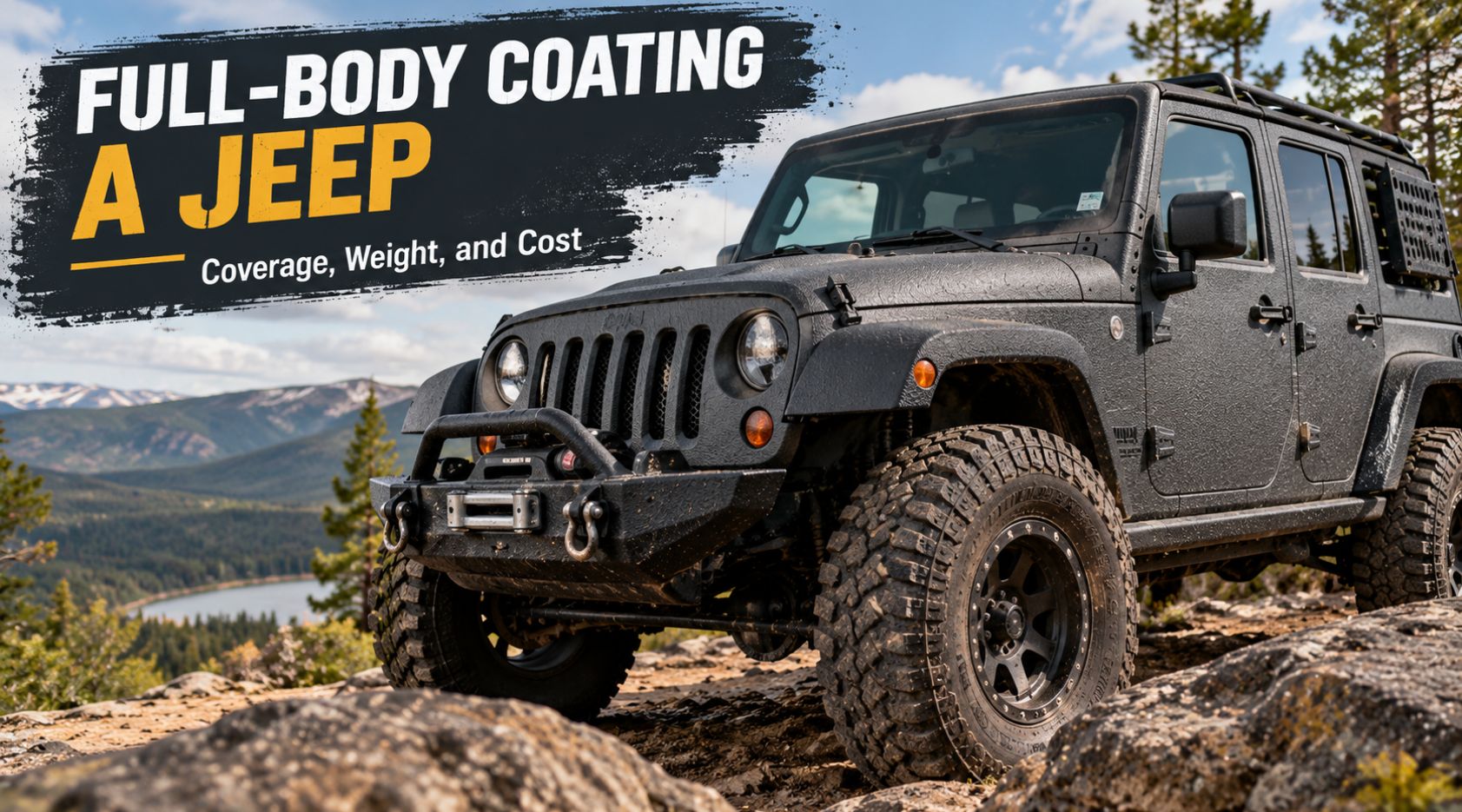
Anyone who’s taken a Jeep off pavement more than a couple times has probably wondered whether a full-body spray coating is worth it, not just for the bed or rocker panels, but the whole exterior, doors, fenders, hood, roof, undercarriage, all of it. It’s a bigger commitment than a standard bedliner job in almost every sense, more surface area, more cost, more prep work, and a permanent change to how the vehicle looks and feels for as long as it’s owned. Before booking that appointment, it’s worth understanding exactly what a Jeep body coating actually covers, how much weight it adds, and what it realistically costs compared to protecting just the bed.
What a Full Jeep Body Coating Actually Covers
A standard bedliner job protects the truck bed or Jeep tub floor and walls. A full-body coating extends that same spray-applied protection across the entire exterior, which typically means rocker panels, fender flares, door skins, hood, cowl, and often the roof if it’s a hardtop, along with the undercarriage and wheel wells where off-road abuse tends to concentrate.
Some owners choose a middle-ground approach rather than going fully committed on every panel, coating just the lower body and rocker panels where rock rash and brush scratches are most likely, while leaving upper body panels in factory paint. This split approach can capture most of the practical protection benefit at a lower cost and with less of a permanent aesthetic commitment than a complete coating.
Trim, glass, lights, and factory badging all need careful masking regardless of how much coverage is chosen, and this masking work is genuinely more involved on a full-body job than on a bed-only application, since there are simply more edges, seams, and delicate components to protect from overspray.
The Weight Question Jeep Owners Actually Care About
This is where a full-body coating differs meaningfully from a bedliner in a way that matters specifically to off-road Jeep builds. A sprayed coating adds weight, and while a bed-only application adds a relatively modest amount concentrated in one area, coating the entire exterior at a comparable thickness adds up across a much larger surface area.
For a Jeep that’s already carrying the weight of a lift kit, heavier off-road tires, aftermarket bumpers, and recovery gear, every additional pound matters more than it would on a stock daily driver. This doesn’t mean a full-body coating is impractical, plenty of built Jeeps run one without issue, but it’s worth having an honest conversation with the applicator about target thickness for exterior panels versus what’s typically used on a bed floor, since a bed needs more build for abrasion resistance while exterior panels can often use a somewhat thinner application while still delivering meaningful protection.
Weight distribution matters too, not just total weight. A heavy coating applied unevenly, thicker in some areas than others, can subtly affect handling characteristics on a vehicle that’s already sensitive to weight changes due to a lifted suspension and larger tire and wheel setup. An experienced applicator familiar with full-body Jeep work will typically account for this rather than treating every panel identically.
What It Actually Costs Compared to a Bedliner
A full-body coating costs significantly more than a standard bed-only application, and the gap is bigger than most owners expect going in. Material cost scales with surface area, and a full exterior has dramatically more surface area than a truck bed or Jeep tub floor alone. Labor cost scales even more steeply, since the masking, prep, and multi-panel application work involved in a full-body job takes considerably longer than spraying a single bed area.
Our breakdown of what a spray-on bedliner really costs covers the factors that drive bed-only pricing, thickness, surface prep, project size, and most of those same factors apply to a full-body job, just multiplied across a much larger area with more complex masking requirements layered on top.
Getting an accurate quote for a full-body job means being specific about exactly which panels are included, since “full body” can mean different things to different shops. Confirming whether the quote includes the undercarriage, wheel wells, and roof, or just the visible exterior panels, avoids a surprising gap between what was expected and what was actually delivered.
Durability and Maintenance for a Fully Coated Jeep
A properly applied full-body coating holds up well against exactly the kind of abuse off-roading dishes out, brush scratches, rock rash, minor impacts, UV exposure, and the general wear of a vehicle that spends real time off pavement. It’s also considerably more forgiving of trail damage than factory paint in a practical sense, since a scratch or scuff on a coated surface is far less visually jarring and far less likely to lead to rust than the same damage on bare or thinly painted metal.
That said, a full-body coating isn’t purely cosmetic protection layered over paint, it fundamentally changes the vehicle’s finish, and that’s a decision worth being fully comfortable with before committing, since reversing it means either living with the coated look permanently or facing a significant removal and repaint project down the line. Our piece on paint protection options covers some of the less permanent alternatives, paint protection film and ceramic coatings among them, worth comparing against a full spray coating for owners who want protection without the permanent commitment.
Rust and Moisture Considerations Across a Full Body
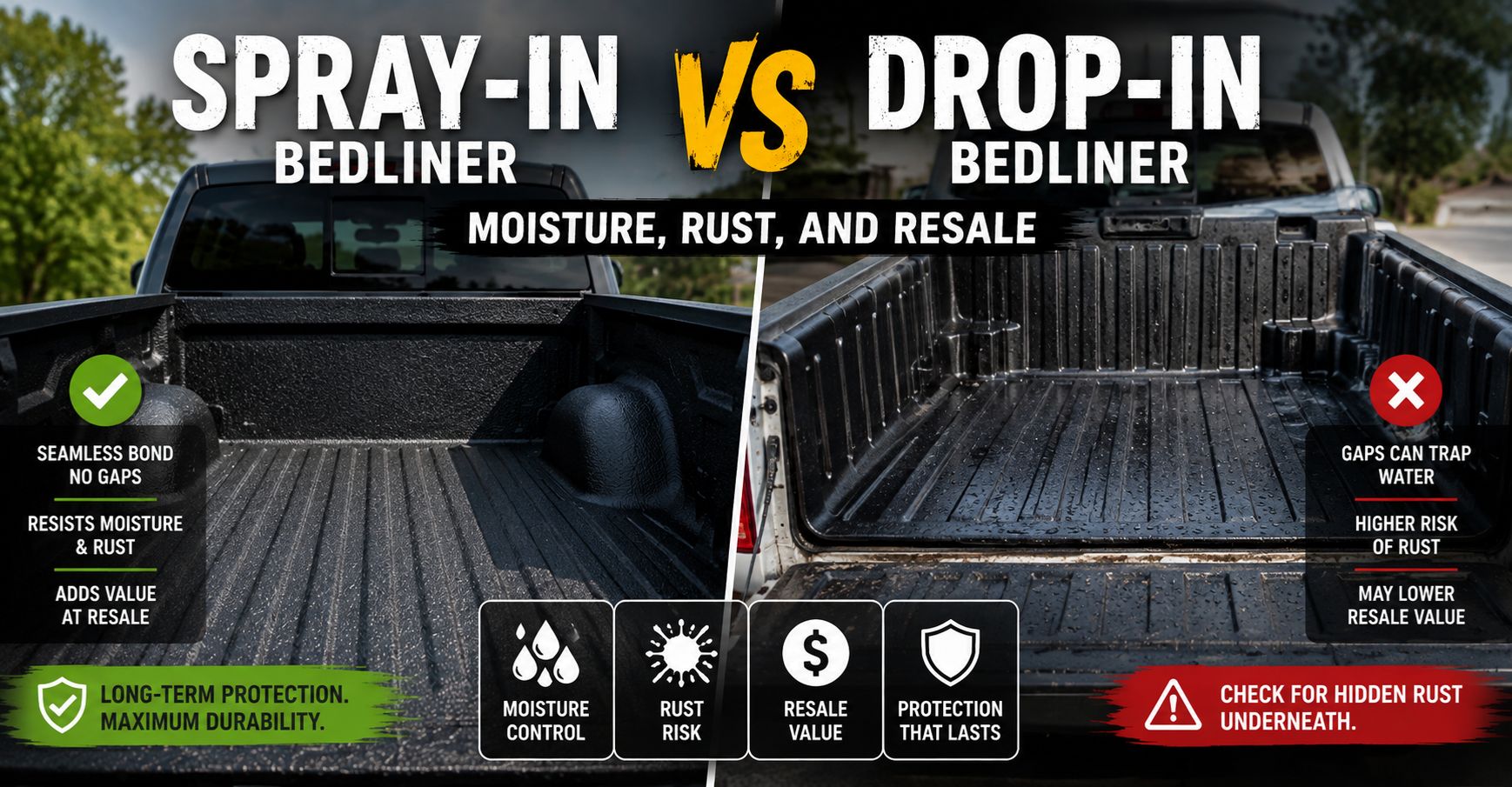
One advantage of a properly applied full-body coating that doesn’t get discussed enough is how it affects moisture and corrosion resistance across the whole vehicle, not just the bed. The same logic that applies to bed coatings, a bonded, seamless layer versus a fitted or partial covering with gaps where moisture can collect, extends to the rest of the body when it’s fully coated. Our comparison of spray-in versus drop-in bedliners on moisture and rust covers this mechanism in detail for the bed specifically, and the same underlying principle, a bonded coating leaving no gap for moisture to hide in, applies just as much to a fully coated rocker panel or wheel well as it does to a bed floor.
Understanding What’s Actually in the Coating
Before committing to a full-body job, it’s worth understanding what the coating material actually is and how it bonds to a painted or bare metal surface, since that affects both durability expectations and how the job needs to be prepped. Our overview of what bedliners are made of and how the application process works covers the chemistry and application basics that apply just as much to a full exterior job as to a bed-only one, and understanding that foundation makes it easier to have an informed conversation with whichever shop ends up doing the work.
Finding a Shop That Actually Does Full-Body Work Well
Not every shop that handles bedliners regularly has real experience with full-body Jeep applications, and it’s worth asking directly rather than assuming. Full-body work involves a different masking workflow, more careful attention to panel gaps and seams, and often a different approach to material thickness across different body sections compared to spraying a single flat bed floor. A shop that’s only ever done bed-only work might still produce a decent result on a full-body job, but asking to see actual photos of previous full-body Jeep projects, not just bed photos, gives a much clearer picture of what to expect than a general reputation for bedliner quality alone.
Things to Consider Before Committing to a Full Body Coating
- Does the project actually need full coverage, or would a partial application on rocker panels and lower body panels capture most of the practical benefit at lower cost and weight?
- Has the applicator discussed appropriate thickness for exterior panels versus bed-floor-level thickness, given the weight sensitivity of a built off-road Jeep?
- Is the quote specific about exactly which panels and areas are included, undercarriage, wheel wells, roof, or just visible body panels?
- Are you comfortable with the permanence of the finish, understanding that reversing a full-body coating is a significant undertaking compared to removing paint protection film?
- Does the shop have specific experience with full-body Jeep applications, since the masking and multi-panel workflow differs meaningfully from a standard bed-only job?
Frequently Asked Questions
How much weight does a full-body Jeep coating actually add?
It depends on coverage area and coating thickness, but a full exterior application adds noticeably more total weight than a bed-only coating simply due to the much larger surface area involved, which is worth discussing with the applicator for an off-road build already carrying added weight from other modifications.
Is a full-body coating reversible if I change my mind later?
Not easily. Removing a cured spray coating and restoring factory paint is a significant, costly undertaking, which is why it’s worth being confident in the decision before committing rather than treating it as a low-stakes trial.
Does a full-body coating protect better than paint protection film?
They protect differently. A sprayed coating offers thicker, more textured protection well-suited to serious off-road abuse, while paint protection film preserves the factory paint finish underneath and is more reversible, which matters for owners who value resale appearance or want a less permanent option.
Can I coat just part of the body instead of the whole Jeep?
Yes, and many owners choose exactly this, coating rocker panels and lower body areas that see the most off-road contact while leaving upper panels in factory paint, which reduces both cost and total added weight.
How much more does full-body coating cost compared to just the bed?
Significantly more, since both material and labor costs scale with the much larger surface area and more complex masking involved, so getting a specific quote for the exact coverage you want is the only reliable way to know actual cost for your vehicle.
Conclusion
A full-body Jeep coating is a meaningfully bigger decision than a standard bedliner job, more surface area, more weight, more cost, and a more permanent commitment to a different finish than factory paint. For a Jeep that spends real time off-road, the durability and rust resistance benefits can be well worth it, but going in with a clear understanding of coverage options, realistic weight considerations for an already-built rig, and an accurate cost picture makes the difference between a satisfying upgrade and an expensive surprise.