DIY Bedliner Products: What They Do and Do Not Deliver
On this page
A DIY spray on bedliner kit shows up in a lot of truck owners’ searches once they start pricing out professional bed liner installation and see the gap between a weekend project and a shop appointment. These kits promise similar protection at a fraction of the cost, applied with tools most people already have in the garage. Some of that promise holds up. Some of it doesn’t, and the gap between the two matters more the harder a truck actually gets used. This guide breaks down what a typical DIY bedliner kit actually contains, what it can realistically deliver, and where it falls short of a professionally applied coating.
Understanding the Basics
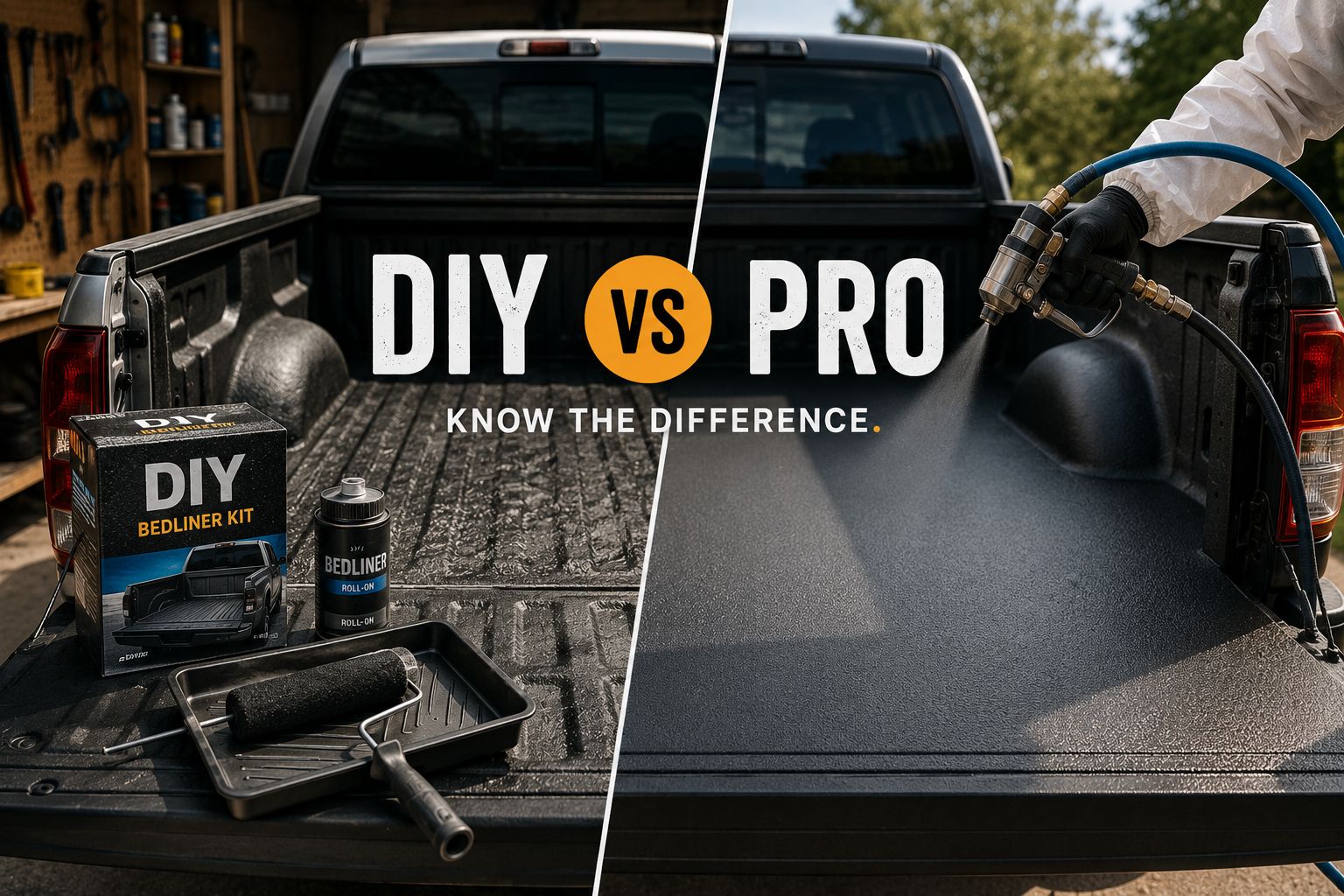
Most products sold as a DIY spray on bedliner kit are not the same chemistry or application method used in professional truck bed coating. Professional applicators typically use plural-component spray equipment that heats and precisely proportions two reactive components, most often polyurea or a polyurethane-based system, and sprays them onto a properly prepared surface where they cure within seconds to a workable film. That equipment is expensive, requires training to run correctly, and is not something a homeowner buys for a single project.
Consumer-facing kits work differently. Most are single-component or simple two-part roll-on, brush-on, or aerosol texture coatings, usually based on polyurethane resin without the plural-component spray system behind them. They are formulated to be applied with a roller, brush, or basic spray gun and to cure at room temperature over a longer window than a professionally sprayed system, often 24 to 72 hours before the bed can handle regular use. The resulting film can look similar to a professional liner once cured, particularly with a textured additive mixed in, but the application method and cure process behind it are genuinely different products aimed at different users.
DIY Spray On Bedliner Kit vs Professional Application: Key Differences
Application method. A DIY spray on bedliner kit is applied by roller, brush, or a basic spray attachment, by someone without specialized training. Professional application uses heated plural-component spray equipment operated by a trained applicator.
Film thickness and consistency. Professional equipment allows an applicator to build a consistent, controlled thickness across the entire bed in a single pass. DIY application depends heavily on the user’s technique, and thickness often varies noticeably between coats and across the bed surface.
Cure time. Professional coatings cure in seconds to a few hours depending on the system. DIY kits generally need multiple coats and a longer overall cure window, often a full day or more before the truck can be used normally.
Surface preparation demands. Both approaches depend heavily on proper surface prep, but a professional applicator brings equipment like media blasting for a consistent mechanical profile. DIY prep usually relies on sanding and solvent wipe-down, which can leave a less consistent bonding surface if not done carefully.
Durability under heavy use. Professionally applied coatings, particularly true polyurea systems, generally hold up better under sustained heavy cargo loads, repeated impact, and long-term UV and chemical exposure. DIY kits can perform well for lighter, more occasional use, but tend to show wear, chipping, or peeling sooner under demanding conditions.
Warranty and accountability. Professional installations often come with a workmanship or product warranty backed by the shop and the coating manufacturer. DIY kits are consumer products with limited warranty coverage, and any application error is the buyer’s own responsibility to fix.
Cost. A DIY kit costs a fraction of professional installation, which is the main reason it appeals to budget-conscious truck owners in the first place.
Comparison Table
| Factor | DIY Spray On Bedliner Kit | Professional Application |
|---|---|---|
| Application method | Roller, brush, or basic spray | Heated plural-component spray equipment |
| Applicator | Truck owner, no special training | Trained professional applicator |
| Film consistency | Varies with user technique | Consistent, controlled thickness |
| Typical cure time | 24 to 72 hours for full cure | Seconds to a few hours, formulation-dependent |
| Surface prep | Sanding and solvent wipe-down | Mechanical profiling, often media blasting |
| Durability under heavy use | Moderate, best for light to occasional use | Generally stronger for sustained heavy use |
| Warranty | Limited or none | Often backed by shop and manufacturer |
| Typical cost | Low | Higher |
What DIY Kits Actually Deliver
For the right use case, a DIY spray on bedliner kit does what it’s supposed to do. It adds a protective, textured layer over bare or worn truck bed metal, reduces the risk of scratches and minor abrasion from everyday cargo, and gives an owner a noticeably improved appearance compared to bare paint or a faded factory liner. For someone with a personal truck used for occasional hauling, light yard work, or weekend projects, a properly applied DIY kit can hold up reasonably well for a meaningful stretch of time. It’s also a genuinely accessible option: no scheduling a shop visit, no waiting list, and a cost that fits a tighter budget.
What DIY Kits Do Not Deliver
Where DIY products fall short is under sustained heavy use, which is exactly the scenario a lot of buyers researching bedliners are trying to protect against. Commercial trucks, work trucks hauling heavy or abrasive material daily, and vehicles exposed to constant loading and unloading put far more stress on a coating than an occasional DIY kit is formulated to handle. Inconsistent film thickness from an uneven roller or brush application creates weak points where wear starts first. Surface prep done without media blasting equipment can leave microscopic contamination or an inadequate mechanical profile that undermines adhesion over time, even when the coating material itself is decent. And because most DIY kits are single-component or basic two-part polyurethane systems rather than true plural-component polyurea, they generally don’t match the impact resistance, flexibility, or long-term abrasion resistance of a professionally sprayed system.
For a closer look at how this plays out against another popular budget option, our comparison of spray-in versus drop-in bedliners covers a similar tradeoff between convenience and long-term performance that applies just as much to DIY kits as it does to pre-formed drop-in liners.
Common Mistakes With DIY Bedliner Kits
Applying over a poorly cleaned surface. Grease, wax, road grime, and even fingerprints can interfere with adhesion. A surface that looks clean to the eye isn’t necessarily clean enough for a coating to bond properly, which is why a proper degreasing step matters even when the bed looks fine.
Skipping or rushing the sanding step. A smooth factory painted surface doesn’t give a coating much to grip onto. Creating a light mechanical profile through sanding is what gives the coating something to bond with, and skipping it is one of the more common reasons a DIY job peels prematurely.
Applying too thick or too thin in a single coat. Rollers and basic spray guns don’t give the same control as professional equipment, and it’s easy to either lay down a coat too thin to hold up or too thick to cure evenly. Following the manufacturer’s recommended coat thickness and recoat window, rather than eyeballing it, produces a more consistent result.
Not allowing enough cure time before use. A DIY coating can look and feel dry to the touch well before it has actually reached full cure. Using the truck bed for regular hauling too soon after application is a common way to damage a coating before it’s had the chance to fully harden.
Ignoring temperature and humidity during application. Most DIY kits have a recommended application temperature and humidity range. Applying outside that range, particularly in cold or damp conditions, can slow the cure or affect how well the coating bonds and levels.
Things to Consider Before Choosing DIY
Be honest about how the truck actually gets used. A DIY kit is a reasonable match for light, occasional use. A truck that hauls heavy or abrasive cargo daily is a much better fit for professional application, where the equipment and material are built for that stress level.
Don’t skip or rush surface prep. Most DIY coating failures trace back to inadequate prep, not the product itself. Full sanding, degreasing, and following the manufacturer’s recoat window between steps matters more than most people expect going in.
Understand the real cost comparison. A DIY kit is cheaper upfront, but if it needs to be redone in a year or two because it wasn’t suited to how the truck gets used, that repeat cost should factor into the decision. Our breakdown of what a spray-on bedliner actually costs is useful context for weighing the DIY price against a professional quote over the long run.
Read the actual product instructions, not just the marketing copy. Cure times, recommended coat count, and application temperature range vary by product, and skipping steps to save time is one of the most common reasons a DIY job underperforms.
Know when it’s worth calling a professional instead. If the truck is a daily work vehicle, or if the budget allows for it, a properly applied professional coating is likely to outlast a DIY kit by a wide enough margin to justify the extra cost. Our guide on how to select a qualified truck bed liner company is a good next step for anyone leaning that direction.
Maintenance
A DIY-coated bed benefits from the same basic care as a professionally coated one: rinsing out debris and grit regularly, avoiding harsh solvents that can degrade the coating, and addressing any chips or worn spots before they spread. Because DIY films tend to be thinner and less consistent than a professionally sprayed coat, they’re often more sensitive to touch-up needs over time, so keeping an eye on high-wear areas like the tailgate edge and rear of the bed is worth doing more frequently than with a professional installation.
Frequently Asked Questions
Is a DIY spray on bedliner kit as durable as a professional coating?
Generally not, particularly under heavy or daily use. It can perform reasonably well for lighter, more occasional truck use if applied carefully.
How long does a DIY bedliner kit last?
This varies by product, application quality, and how the truck is used. Light use with careful application tends to hold up longer than heavy daily use or a rushed application.
Can a DIY kit be applied over an old, worn factory liner?
It depends on the condition of the existing surface. Loose, peeling, or heavily worn material generally needs to be removed first for a new coating to bond properly.
What tools does a DIY spray on bedliner kit actually require?
Most kits include the coating material along with basic application tools like a roller or brush. Surface prep tools such as sandpaper, a degreaser, and masking materials are usually a separate purchase.
Is it worth trying DIY first before paying for professional application?
For a personal truck with light use, it can be a reasonable way to test the look and basic protection before committing to a bigger spend. For a work truck under heavy daily stress, professional application is generally the more reliable choice from the start.
Conclusion
A DIY spray on bedliner kit is a real option, not a gimmick, but it is a different product from a professionally sprayed coating, not a cheaper version of the same thing. For light, occasional truck use and a careful, patient application, it can deliver solid protection at a fraction of the cost. For a truck that sees heavy daily cargo, constant loading, or demanding job site conditions, the gap between DIY and professional application tends to show up sooner than most buyers expect. Matching the choice to how the truck actually gets used is the difference between a DIY project that holds up and one that needs to be redone within a year.