
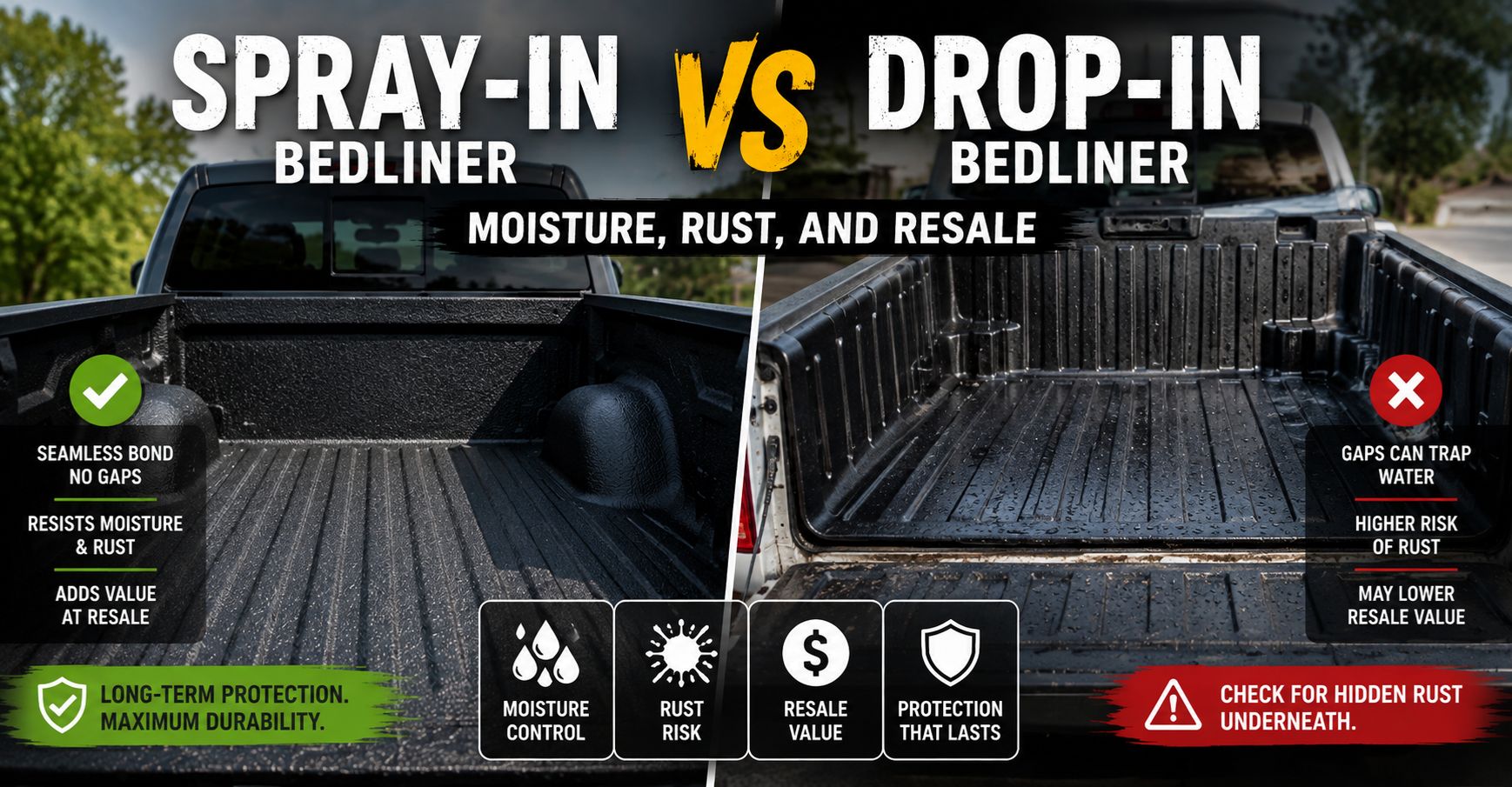
Spray-In vs. Drop-In Bedliners: Moisture, Rust, and Resale
When comparing spray-in vs. drop-in bedliners, most truck owners focus on the upfront cost and installation process. A drop-in bedliner looks like the easier choice: buy it, drop it in, and you’re done. A spray-in bedliner takes more time and costs more upfront, but the real differences become clear months or years later, especially when it comes to moisture, rust, and long-term resale value.
This guide compares spray-in and drop-in bedliners specifically on moisture handling, rust risk, and how each one affects resale value, since those three factors matter more to a truck’s long-term condition than looks or upfront cost.
Spray-In vs. Drop-In Bedliners: Understanding the Basics
A drop-in bedliner is a pre-formed plastic tub, usually ABS or a similar rigid plastic, manufactured to a standard bed size and simply set into the truck bed. It sits on top of the bed floor and walls rather than bonding to them, and it’s typically held in place with clips, bolts, or its own weight and shape.
A spray-in bedliner is a coating, commonly polyurea or a polyurethane blend, sprayed directly onto the bed’s metal surface, where it bonds to the substrate and cures into a seamless layer that follows the exact contours of the bed.
That single difference, bonded coating versus a separate physical liner sitting on top, is what drives almost everything else in this comparison.
Moisture and Trapped Water
This is where the two options diverge the most. A drop-in liner is not sealed to the bed. Gaps exist between the liner and the bed floor, walls, and around the tailgate area, and water, whether from rain, washing, or hauling wet cargo, can work its way into those gaps. Once water is trapped between the liner and the bed metal, it often has nowhere to drain and no airflow to help it evaporate.
A properly applied spray-in bedliner eliminates that gap entirely because the coating bonds directly to the metal. There’s no cavity for water to collect in, since the coating and the bed surface are effectively one continuous layer.
Rust Risk Over Time
Trapped moisture is the direct cause of the rust problems most commonly associated with drop-in liners. Because the water sits against bare or painted metal with no drainage and no visibility, rust can develop and spread underneath the liner for a long time before a truck owner notices anything, often not until the liner is removed for some other reason and the damage is already extensive.
Spray-in bedliners carry a meaningfully lower rust risk specifically because there’s no hidden cavity where water can sit against the metal undetected. Surface prep before application matters here too. A bed that isn’t properly cleaned and prepped before spraying can trap contaminants under the coating itself, so rust risk with a spray-in liner comes down heavily on getting the prep work right.
Resale Value and Buyer Perception
Truck buyers and appraisers increasingly view a professionally applied spray-in bedliner as a plus on a used truck listing, both because of the protection it implies and because a well-done spray-in job signals the seller took reasonable care of the vehicle. A drop-in liner is more of a neutral, and sometimes a red flag, since a cautious buyer may specifically ask to remove it and check for rust before finalizing a purchase.
That inspection moment is where drop-in liners often lose value in a resale scenario. If rust or moisture damage is found underneath, it can tank a buyer’s confidence in the whole vehicle, not just the bed, even if the rest of the truck is in good shape.
Other Practical Differences
Beyond moisture and resale, a few other factors are worth weighing:
- Cost. Drop-in liners are generally cheaper upfront and can be installed without professional help. For a full look at how spray-in pricing breaks down, see our spray-on bedliner cost guide.
- Fit and coverage. Drop-in liners are made to standard bed dimensions and may not perfectly match every bed, especially with aftermarket modifications. Spray-in coatings conform exactly to the bed’s actual shape.
- Removability. A drop-in liner can be taken out, which some owners like for resale or for switching liners. A spray-in coating is permanent.
- Noise and rattle. Drop-in liners can shift slightly and rattle over time, particularly as clips or fasteners wear. Spray-in coatings don’t move independently of the bed since they’re bonded to it.
- Appearance over time. Drop-in liners can fade, warp, or crack with UV and temperature exposure. Spray-in coatings, when properly top-coated for UV resistance, tend to hold their finish longer, though this varies by product.
Spray-In vs. Drop-In Comparison
| Factor | Spray-In | Drop-In |
|---|---|---|
| Moisture trapping | Minimal, coating is bonded with no gap | Higher risk, gaps allow water to collect |
| Rust risk | Lower, assuming proper surface prep | Higher, especially if not inspected regularly |
| Upfront cost | Higher | Lower |
| Installation | Professional application required | Can often be self-installed |
| Removability | Permanent | Removable |
| Resale perception | Generally viewed as a positive | Neutral to a caution flag for buyers |
| Fit | Conforms exactly to bed shape | Standard sizing, may not match custom beds |
Which Option Fits Which Owner
Spray-in tends to make sense for:
- Owners planning to keep the truck long term and wanting to protect resale value
- Trucks that regularly haul wet or muddy cargo
- Anyone who wants a seamless, bonded finish without gaps to maintain
Drop-in tends to make sense for:
- Owners on a tight budget who want basic protection now
- Anyone who wants the option to remove the liner later, for resale or a liner swap
- Lighter-use trucks where occasional inspection for trapped moisture is a manageable tradeoff
For background on how spray-in coatings are actually formulated and applied, our guide on what bedliners are made of and how the application process works covers the chemistry side of this comparison in more depth.
Things to Consider Before You Choose
- How often does the truck haul wet, muddy, or corrosive cargo that could work its way under a drop-in liner?
- Do you plan to keep the truck long enough for resale value to matter?
- Is a lower upfront cost worth the added maintenance of periodically checking under a drop-in liner for trapped moisture?
- If going drop-in, does it fit the bed’s exact dimensions, including any aftermarket modifications?
- If going spray-in, is the shop doing proper surface prep, since rust risk with a spray-in coating comes down to prep quality?
Maintenance and Inspection
Drop-in liners need periodic removal and inspection, ideally at least once or twice a year, to check for trapped water, debris buildup, or early rust at the edges and corners where gaps are most likely to form. Spray-in coatings need far less intervention since there’s no cavity to check, though any deep gouge that exposes bare metal should be addressed before it becomes an entry point for moisture. Choosing a shop that does the prep work correctly the first time matters more for long-term rust prevention than any maintenance routine after the fact. Our guide on what discoloration in a bedliner can indicate covers some of the early warning signs worth watching for either way.
Frequently Asked Questions
Does a drop-in bedliner always cause rust?
Not always, but it creates the conditions where rust is more likely to develop unnoticed, since water can collect between the liner and the bed metal without being visible during normal use.
Is a spray-in bedliner completely rust-proof?
No coating is truly rust-proof forever. A properly applied spray-in bedliner significantly reduces rust risk by eliminating the gap where moisture collects, but exposed metal from a deep gouge or improper surface prep before application can still lead to rust.
Which option is better for resale value?
A professionally applied spray-in bedliner is generally viewed more favorably by buyers, partly for the protection itself and partly because a drop-in liner invites a buyer to check underneath for damage before making an offer.
Can I switch from a drop-in liner to a spray-in coating later?
Yes, in most cases. The drop-in liner is removed, the bed is inspected and repaired if needed, and then prepped and coated. Any existing rust found during that process needs to be addressed before the spray-in coating goes on.
How often should I check under a drop-in liner?
At least once or twice a year is a reasonable baseline, with more frequent checks if the truck regularly hauls wet or muddy cargo.
Conclusion
When comparing Spray-In vs. Drop-In Bedliners, both options protect a truck bed from everyday wear, but they handle moisture in fundamentally different ways. That difference often determines whether a truck bed stays protected for years or develops hidden rust damage over time.
A drop-in bedliner offers a lower-cost, removable option that trades some long-term risk for upfront savings. A spray-in bedliner costs more and requires professional installation, but it eliminates the gap where moisture and rust problems typically begin.
Ultimately, the best choice depends on how you use your truck, your budget, and how long you plan to keep it. If long-term protection, rust prevention, and resale value are your priorities, a professionally applied spray-in bedliner is often the better investment.
0 comments