
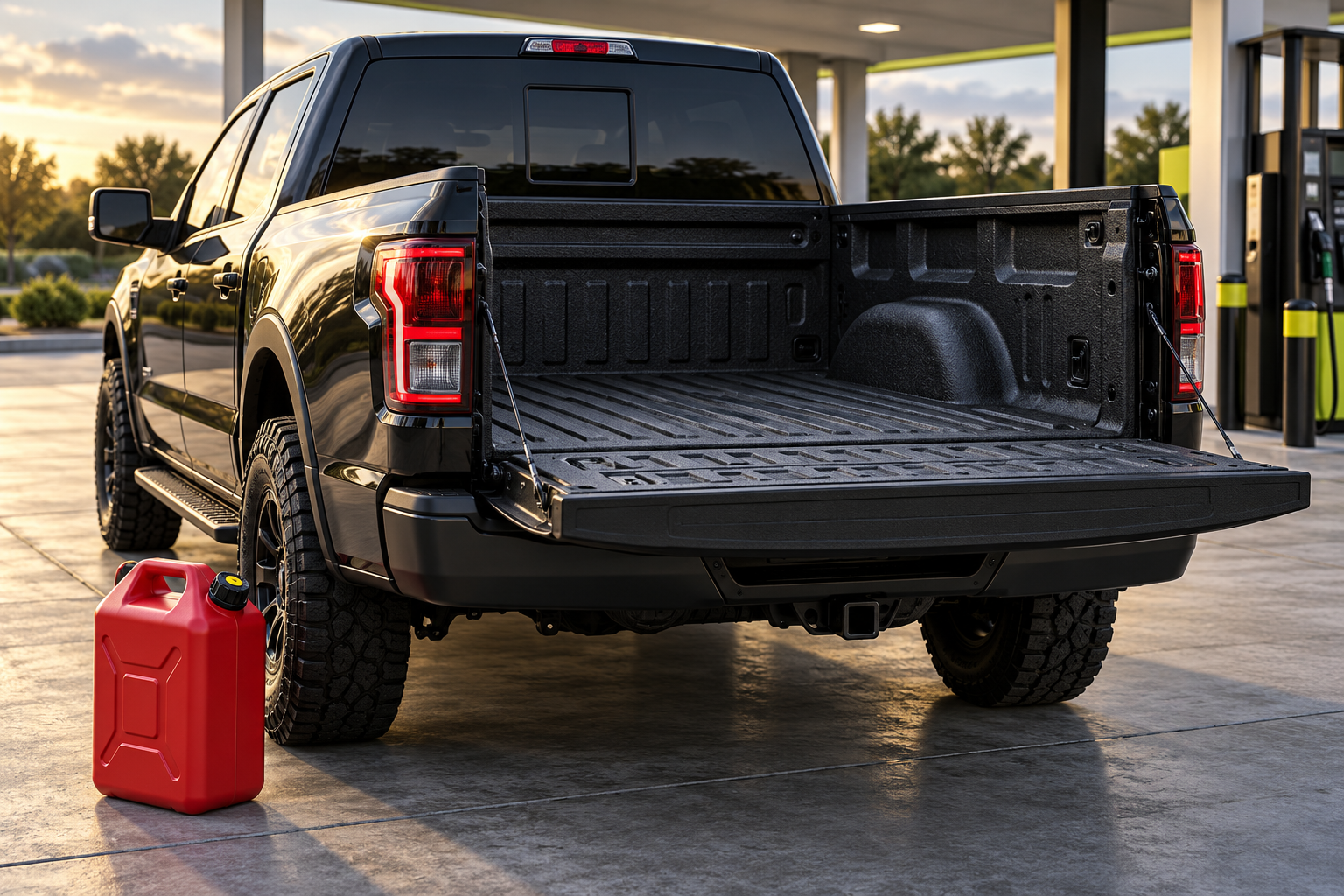
Fuel Cans and Bedliners: Put the Container on the Ground Before Filling
Before filling a portable gasoline container at a service station, take it out of the pickup and place it on the ground. Do this regardless of how durable, chemical-resistant or expensive the bedliner is. A protective coating is not evidence that filling a container in the truck bed is safe.
The U.S. Consumer Product Safety Commission’s fuel-container guidance explicitly says to place the container on the ground when filling at a gas station. It also calls for containers designed for the fuel, following their instructions and keeping fuel away from ignition sources. Start with that rule rather than trying to classify a liner by appearance.
Why a bedliner belongs in this conversation
A NIOSH hazard report on gasoline-container fires documented incidents involving containers filled in pickup beds with plastic liners or inside vehicles with carpeted surfaces. The report explains how insulating surfaces can interfere with dissipation of static charge. It describes incidents involving both metal and plastic containers.
That report dates to 1998. It is useful evidence of the mechanism and the historical incidents, not a laboratory classification of every modern spray-applied coating. The current CPSC ground-filling instruction is the practical rule for today’s owner. Neither source provides a basis for declaring your particular bedliner safe for in-bed filling.
Chemical resistance answers a different question
A coating specification may discuss resistance to certain chemicals under stated conditions. That information concerns the material’s response to exposure. It does not, by itself, establish the electrical behavior of a complete truck bed, container and dispensing arrangement.
Do not convert a claim such as “fuel resistant” into permission to fill cans on the liner. Likewise, the words “polyurea,” “polyurethane,” “rubberized” or “professional grade” do not replace fuel-container instructions. If a seller makes a specific safety claim, ask for the exact supporting documentation rather than inferring it from the product category.
Set up before starting the pump
Use a suitable fuel container in sound condition and follow its current instructions. Place it on the ground before filling, rather than moving it after dispensing has started. Lowering the tailgate still leaves the container on part of the truck; it does not meet the ground-placement instruction.
NIOSH’s report also advises keeping the dispensing nozzle in contact with the container’s inlet during filling. Follow the station’s directions and the container’s filling instructions, including its capacity limits. Do not invent a bonding arrangement, add wires to the truck or alter the bedliner as a substitute for the recommended handling method.
Keep the task separate from loading the truck
It is easy for a busy stop to combine fuel, food, equipment and passenger needs. Finish the container-filling task with your attention on it. Do not leave a container being filled while rearranging cargo or walking into the store.
After filling, close the container as its manufacturer directs and check that it is ready for handling before arranging transport. Secure and transport it according to the container instructions and applicable requirements. This article does not establish that a particular rack, tonneau-covered bed or enclosed storage space is appropriate for carrying fuel.
A spill is not a coating-performance test
If fuel spills at a station, stop the activity and alert station staff so they can direct the response. Do not treat the liner’s chemical-resistance claim as a reason to continue filling or casually wash the spill away. Avoid ignition sources and follow the station’s instructions.
Questions about cleaning a liner after exposure belong with the coating manufacturer once the immediate fuel hazard has been addressed. The appropriate cleaning method depends on the actual coating and circumstances. A generic solvent recommendation can introduce another problem, so avoid experimenting with whatever cleaner is nearby.
One simple habit travels between trucks
The ground-placement habit works whether you own the truck, borrow one or change bedliners later. It avoids relying on undocumented assumptions about the material under the can. Share the rule with anyone who uses the vehicle to collect fuel, along with the container’s own instructions.
A bedliner can have a useful role protecting a cargo surface, but it should not be asked to prove a fuel-handling safety claim it was never documented to satisfy. Remove the portable container, set it on the ground and follow the authoritative filling guidance.
0 comments